Thursday, 29 December 2011

Mum

For once something that isn't cat-related, but a note to say that my Mum died today after a painful couple of weeks with a broken hip.  I'm very glad her suffering has ended, but miss her more than I can say.
Here she is blowing her birthday candles out two years ago:


And here's one of her smacking me when I was a little girl, many decades ago!

She was 96 years old this year.  I feel numb, and distraught, in turns.  Rest in peace, Mum.

Monday, 19 December 2011

Merry Christmas from the Vieuxtemps cats!

Vieuxtemps Katia, by Shirley Fullarton
Shirley kindly gave me permission to use this beautiful painting for my Christmas blog.  I'd like to wish all my readers a wonderful Christmas and an even better New Year.

Love to you all from Bob, Mary-Rose, Butz the Airedale and the Vieuxtemps Norwegian Forest Cats and kittens xx

Monday, 12 December 2011

Deafness in white cats

Vieuxtemps Avedine
Although we love all colours of Norwegian Forest Cats here at Vieuxtemps, pure white Norwegian Forest Cats (‘Snowcats’) will always have a special place in our hearts.  However we stopped breeding this colour some years ago as we did not want to produce deaf kittens.


In fact the most frequently asked question in relation to white cats is "are they deaf?" The answer is: some are and some aren't. Statistically, over the general population of cats, various studies have shown that most white cats both pedigree and non-pedigree are not in fact deaf, but many are. Slightly more blue-eyed white cats are deaf than others. Deafness can affect green-eyed, odd-eyed and orange-eyed white cats too.


When do you know if a white kitten is hard of hearing?
It usually becomes apparent to the breeder when the kitten reaches about four weeks of age; the main difference is that the deaf kitten tends to sleep more soundly, and does not run away from the vacuum cleaner. (I have had other cats who do not mind loud noises however -particularly Honeysuckle, who was a hoover-riding tortie!) By the time the kitten leaves home, s/he is often so well-adjusted that it is difficult to tell whether or not s/he can hear, except by scientific tests. There are so many other ways that alert a cat to its environment - vibrations on the paws, guard-hairs and whiskers can tell the deaf cat so much that their reactions are almost exactly the same as those of a fully hearing cat. In order to BAER test the hearing of our breeding stock, we used the laboratory at the Animal Health Trust at Newmarket, Suffolk.

I have on several occasions come across cases where members of the public have bought white NFC kittens having been mislead about their hearing status.  All I can say is, if a breeder sells a deaf kitten without explaining this to the new owner, either they are being dishonest, or if they are genuinely ignorant of the fact they must have not had sufficient interaction with the kitten whilst s/he was growing up.  In either case it is shameful and should be reported.

It is difficult to "breed out" deafness as deaf parents are no more likely to have deaf kittens than hearing parents, and vice versa. Here at Vieuxtemps we generally asked that owners keep their white kittens/cats indoors, regardless of whether they are deaf. This is because they are so stunningly beautiful and clearly pedigree, that there is a risk of kidnap! 
Grand Premier Vieuxtemps Maja Gradnos - photo by Alan Robinson
(Thanks to Heather Bird!)
Tabby NFCs allowed to roam free are much less noticeable to the general public. However one deaf white kitten that we sold (Maja above, now aged twelve) lives with her human slaves and three other Forest Cats in many acres of wonderful grounds and her owners do allow her total freedom to roam. She is as capable as most other cats. We agreed to this because Heather had previously had another deaf white cat who had lived to age 15 in the same circumstances. Maja tolerates cat shows but is not thrilled by them, as she was nearly 2 years old before her first one; I have witnessed other deaf cats who are totally relaxed at shows and do not believe that deafness is a hindrance to a show career, so long as the cat is taken early enough. In fact because they are shielded from loud noises it is, if anything, an advantage in the show hall.  They are allowed to compete at GCCF shows but not at FIFe shows.

Living with a deaf white cat is no less rewarding than living with a cat of normal hearing ability. Deaf cats are, if anything, extra magical. It is usual for a cat to be fully hearing or completely deaf in one or both ears, not partially deaf or partially hearing within each ear. We kept one of our deaf kittens to see what it was like to live with a deaf white cat. It was a moving, marvellous experience and Vieuxtemps Avedine (at the top of the page) is one of our most precious memories.


Sunday, 27 November 2011

And then there were two....

Quink has been a very conscientious dad.  He assisted at the birth, changed their nappies when they were younger, taught them the lore of the Forest Cat and how to hunt and kill catnip mice.  He thinks they are the bestest kittens in the world, but is slightly bemused when they use him as a trampoline.  
Quink with his daughters Lindy (brown ticked tabby) and Kyrie (solid black like her dad).  The girls are three and a half months old; Quink is five years old.
I snapped this family portrait during a quieter moment today, when they had just woken up from a catnap.

Thursday, 24 November 2011

Goodbye Rossi!

The time has come for the kittens to leave home.  How did the weeks pass so quickly?  Rossi joined her new humans and a new feline friend yesterday.  She should feel at home as Julie is Danish, and Rossi's ancestors come from Denmark on both sides of her pedigree.  Here is her last moment at home after she had packed her bags, which included a week's supply of the food and litter she is used to, her favourite toy (a cat-tunnel), lots of paperwork and many sad kisses from me.
Rossi got into the carrier that would take her to her new home -  little knowing what was in store!  But I am sure a good life awaits her, with lots of love and fun.
Meanwhile, Lindy, who is a real mummy's girl, snuggled up to Jet, unaware that she too will be leaving home in a week and a half.  
Jet with Lindy


I'm very glad that Kyrie is staying or the place would seem quite bereft.

Wednesday, 9 November 2011

Coats of many colours

Coat colours and patterns in the Norwegian Forest Cat


The face of a silver tortie tabby and white kitten - she has
red, black, white and silver colours in her coat

At cat shows, NFCs get no points for colour, although a few colours are not allowed (eg chocolate, lilac or Siamese pointing).  However it is interesting to be able to understand what colours might appear from a particular mating.

All cats have eight pairs of genes that affect how their coats look in terms of colour and pattern. One gene from each pair comes from the cat’s mother, and the other from the cat’s father. Some genes dominate over others.  For any recessive gene to “work” it has to be doubled up - e.g. a cat with one (recessive) dilute and one (dominant) non dilute gene will not look dilute. This article ignores the “new colours” – amber and light amber, previously known as the “x” colours – as they are different, recently discovered and probably unique to NFCs.  I have not worked with amber or light amber as I don't particularly like them, but I have had kittens of all other possible colour combinations over the years.

1. Black, which is the base colour
All cats are really black cats in disguise!  The other genes, 2-8, listed below modify appearance.  
Hey, I'm unmodified!  So I look black all over.  And I'm four weeks old, so there.
2. Orange or not Orange?
Although we call the colour red, genetically it is given the code O for orange (or a small o for not orange). O is a sex linked gene. It attaches itself to the X chromosome. Males are XY and females are XX. So if a male is red, then when he has a daughter he always passes on his X chromosome to her, and hence always passes on his O gene. That’s why the female kittens from red studs invariably have some red fur.
The kitten on the left is a red and white girl fathered by a tortie mother
and a red  tabby and white father
A female with one red gene will be a tortie. A female with two red genes (which she has to get one from her father and one from her mother) will be red.
Red has a complication in that the way the pigment works on the cat hair means there is always a tabby pattern evident. Hence it is difficult to tell visually if a red or cream cat is tabby or not.
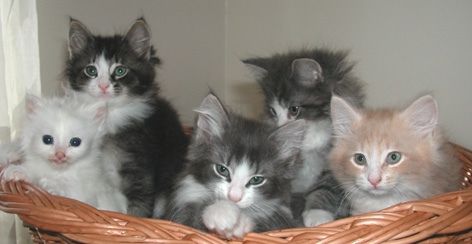
A variety of Vieuxtemps kittens including a cream tabby boy, right - cream is the
dilute version of red.  (The funny little white one from a different, younger, litter!)
3. Dilute or non dilute?
The red or black is affected by the dilute gene to produce cream or blue respectively. Dilute is recessive to full colour. So if you have a dilute cat, both genes on this locus must be dilute. If you have a full colour cat, it may be carrying one dilute gene. If a full colour cat had a dilute parent, it MUST carry a dilute gene. If a cat doesn’t carry a dilute gene, then mating it with a dilute cat will never produce dilute kittens. However dilute genes can be carried from quite a long way back in the pedigree. D = dense, d= dilute. So DD and D cats do not look dilute – dd cats do look dilute.
Ragna, a dilute cat - she was a blue ticked tabby
4. The White Spotting Gene
Designated S and so called to distinguish it from the completely separate white masking gene – the spotting gene gives the Forest Cat white areas on its body. This can be completely variable, from a tiny white tip on the tail to nearly all white with just a few coloured blotches.  The white patches don't have to be actual spots! The typical look is white inverted V on nose and white paws and tummy. There are no rules as to where and how much white should appear. The spotting gene is dominant. Hence you cannot get a kitten with any white areas unless at least one parent has the white spotting gene.
This white queen (who clearly has the white masking gene, but we cannot see if she has the white spotting gene) has a brown tabby kitten, snoozing bottom right, who clearly has the white spotting gene giving him the white 'V' on his face typical of many NFCs.
5. The Inhibitor gene - silver/smoke or not?
The inhibitor gene I prevents pigment from colouring the bottom part of every hair shaft. Hence if you look at the roots of hair of a silver or smoke cat, they should be pure white. However there are many grades of silver, and as no-one tends to breed NFCs for colour (as colour has zero points in the Standard of Points) you do sometimes get very low-grade silvers where it is difficult to see. Some cats like this are wrongly registered but will later produce silver progeny with a non silver stud, which means they have to be re-registered correctly. Smoke and silver are the same, except for the fact that silver is tabby and smoke is solid colour. The inhibitor gene is dominant (as far as we know). Other forms of smoke –eg the very slight colour tipping of Chinchillas, are not found in NFCs.
Tarnishing – it is wrong of judges to punish unless as a point of dividing otherwise equally good cats. Silver and smoke can combine with any colour –eg red smoke, blue silver and so on. If speaking of a silver tabby cat, one is referring to the default black silver.
Vieuxtemps Rosa, silver tabby and white kitten aged eleven weeks
6. Tabby or non tabby?
Do not confuse the gene that says that a cat shows a tabby pattern or not with the gene that says which particular pattern the cat has (see 7 below).
Tabby is dominant over non tabby.  In genetics, the word Agouti is used for tabby and the gene has code A (tabby) a (non tabby).
A cat without the Agouti gene means it will appear solid coloured. Cats cannot carry the Agouti gene. So two solid cats can never have tabby offspring. Tabby cats can carry solid genes however, so two tabby cats can have solid offspring.
The effect of the Agouti gene on a black coat is to make the black brown. Hence, a brown tabby cat is genetically a black tabby (which is the term used in FIFe).

This brown tabby and white kitten, Vieuxstemps Snygging, is technically
black and white with added tabby!
7. What tabby pattern?
There are four patterns:
Classic(blotched)
Mackerel
Spotted
Ticked
All NFCs have a pair of tabby pattern genes, even if they do not have the gene that makes them a tabby cat. Sometimes “ghost” markings can be seen in solid coloured kittens, in some lights. The markings can always be seen in a red or cream cat, regardless whether or not it is tabby.
Spotted is actually classic or blotched, but with a broken pattern. In other breeds (such as Bengals) there are other spotted genes (eg rosettes, like leopards) and also the marble pattern, but not in NFCs.
Classic is recessive to mackerel, and mackerel is recessive to ticked. Ticked coats are sometimes known as “wild pattern” abroad as they are similar to the coat of a wild rabbit, hare, fox etc. There are no stripes or spots but instead each hair has several bands of contrasting colour, with the darkest colour at the tip.
There is some controversy over ticked tabby NFCs outside of Norway. Some people suspect that Somalis have been bred with NFCs to get this pattern. However going back to ticked novices, they were found in the Norwegian countryside the same as the other patterns. We do not know what is behind any of our Forest Cats but we do know that the Vikings travelled to places where there were ticked cats.

Silver tortie tabby girl showing classic tabby pattern
8. The White Masking Gene
You can think of the white masking gene as being a white overcoat on top of the cat’s normal colour. A white cat can be any other colour underneath the white. Eye colour is affected – eyes are blue, green, orange/yellow or blue plus one of the others(“odd eyed”). The eye colour inheritance seems completely random although blue eyes are associated with a slightly greater incidence of deafness. If a cat is solid white, it has at least one W gene, which is dominant. If the cat isn’t white, it must have two white w genes (ie non white masking). This gene is associated with deafness (but the majority of white kittens can hear). I used to specialise in white NFCs because I think they are so very beautiful, but I stopped using them for breeding as although very few of my kittens were deaf I just didn't want to breed deaf kittens.
Kyrrekatt Kohinoor, one of my very first Forest Cats
(photo by Kevin Reah)
If you are a novice breeder and need guidance about which colours are likely to appear out of any particular mating, you are welcome to contact Mary-Rose for help.


Sunday, 30 October 2011

The Ears of the Norwegian Forest Cat


In the Standard of Points for the Norwegian Forest Cat the ears are given 10% of the total. Although this isn’t a huge proportion of the overall points, if an otherwise near-perfect NFC has ears that are noticeably too small or the wrong shape or set it can “throw” the whole look of that cat. Looking back I realise that when I became involved with NFCs the best part of two decades ago my cats tended to have ears that were too small, and sometimes wrongly placed too. This was partly due to the fact that the GCCF Standard used to say that “the width between the ears should be no greater than the width at the base of one ear”. This encouraged breeders to concentrate on that factor at the expense of others and the phrase has now been removed, in accordance with the FIFe standard that is used in Norway and elsewhere.
Sonata's ears looked sufficiently large when she was young

Sonata as an adult, with full coat - the ears are only just
big enough and perhaps could be a little larger for balance
Size
The ears should be large – in particular, wide at the base, and also tall. Kittens need to have absolutely HUGE ears as they will inevitably become smaller in relation to the rest of the head as the cat matures.  The Standard says that small ears are a with-holding fault.

I've heard some people argue that cats from cold climates should have small ears to preserve heat.  I guess it's equally important that they hear well in order to help them catch the sparse prey.  And just think of tigers and lions - although they originate from hot countries they have tiny ears!

Above is Sonata, aged 6 months where her ears look good, and again at maturity when they are only just large enough - or, rather, they stayed the same while the rest of her grew.  Remember that NFCs continue to develop for around four years.  She does have nice little tufts on top - I always think it spoils a Forest Cat if there are no tufts at all.  But some nowadays are developing huge tufts that are extreme in the opposite direction and can look almost comical!  Moderation is the key.

Ragna's ears were too rounded at the top, although they had good 'furnishings'
Shape
The ears should be triangular in shape, ending in a pointed tip – NOT a rounded tip.  Most of my cats have nice ear-tops but Ragna, above, had ears that were too rounded (of course she had other nice qualities that made up for this and allowed her to easily reach GCCF Champion status.)


Furnishings
As well has having tufts at the tip the ears should also have long hairs coming out of the ears. I have noticed that some people seem to confuse tufts with ear furnishings – no, tufts are not hair coming out of the ears, they are the tips on top that just give a nice wild-looking finish to the cat.  Proper ear furnishings will help to keep the cat's ears warm in the cold Scandinavian winters and now that our cats are often kept indoors or in southern climates we must ensure they don't lose this beautiful trait.
Velcro has appropriately extravagant ear furnishings

Set
The ears should be so placed that they follow the sidelines of the head, which is also a triangular shape. They should not sag down at the side of the head, nor be pointing too upright, but should be a continuation of the triangle.  Often a cat's head will widen (particularly in entire males) meaning that ears can end up too low on the sides of the head.  Much worse than this is when you get ears that are too upright, called 'rabbit ears'.  Sometimes kittens have 'rabbit ears' which then become correctly positioned as they mature.  It's a case of knowing the lines - see what the ancestors' ears are like.
Vieuxtemps Avedine was a very beautiful kitten, but at the stage above her ears are a little too upright - can you see how the outer line of the ears doesn't follow the sidelines of her head, thus spoiling that all-important 'triangle' effect?
I consider my ex-stud cat Pelle’s ears to be near perfect and they continued to look good right into his senior years, although his furnishings were sparse:
Pelle greatly helped improve the ears of the Vieuxtemps line
both in terms of size, shape and position
All these little details add up to a cat that has the correct look of an alert and capable hunter – which indeed the Norwegian Forest Cat is.

You can read the full Standard of Points here